
Travis Previous Resident Sources by Era
The backward trail of one Travis address changes with the period being researched. A current parcel gives the bridge to the recorded title chain. The title chain can lead to earlier owners, but it does not identify every household. Reverse directories and census sources add the person-and-address layer. Start with the source that matches the date range, then carry the exact street form, parcel account, legal description, record date, and page or document reference to the next source.
| Source | Years It Covers | Where Held | What It Shows |
|---|---|---|---|
| TCC Search deed index | Mid-1980s to present | County Clerk online real-estate search | Recorded parties, instrument, volume/page or document number, and image link where available |
| Historic deeds and indexes | Deeds 1840-1919; indexes 1842-1924 | Portal to Texas History digitization | Older title entries and deed-book research leads |
| Older deed books and microfilm | Much of 1919 through the mid-1980s | County Archives and Clerk research routes | Bridge across the main online coverage gap |
| Austin city directories | 1872 to current, with gaps | Austin History Center and selected Portal volumes | Dated address, name, spouse, occupation, and publication-status clues |
| Criss-cross directories | 1957 forward | Austin History Center | Address-to-occupant or subscriber lead |
| Tax, land, and city-lot records | 1840-1995; 1877-1936; 1879-1974 | Travis County historical collections | Owner, lot, value, and year-specific property context |
For an address in Austin, use city materials as a companion to county sources. For a location elsewhere in Travis County, first confirm the jurisdiction and then use the county parcel, deed, archive, and relevant municipal-addressing routes. A person named on an instrument, tax roll, permit, or directory is tied to that particular record, not automatically to every household at the address.
Travis Parcel Records Before Names
Begin with the address form that the local record systems recognize. Austin Address Management can help normalize a house number, street name, jurisdiction, unit or building, parcel ID, place ID or RSN, valid range, and annexation history. Then use the Travis Central Appraisal District property search for its owner, property-address, account-number, or DBA modes. Search tips say to omit street suffixes such as St or Ave if they block a result, and to try the street name alone when a number fails.
TCAD distinguishes a property or situs address from a mailing address. The situs identifies the parcel location. The mailing address can belong to an owner, representative, lender, or another location, so it is not proof that a person lived at the property. Capture the account or PID and legal description, then use the Travis County GIS viewer for parcel and boundary context.
Note: A parcel is a property record, while a directory line is a dated publication association, and they should remain separate in the research notes.
Trace a Travis Deed Chain Backward
Deeds are not arranged by street address. The Travis County deed-research guide starts with the current TCAD owner and then works through the County Clerk's grantor and grantee indexes. A direct or grantor index follows the seller or transferor. A reverse or indirect grantee index follows the buyer or recipient. Entries are arranged chronologically by the first two letters of a surname and first name, so spelling variants, initials, name changes, and same-name people must be checked.
- Record the current TCAD owner, parcel account, and legal description without treating the owner as an occupant.
- Use the owner name in the County Clerk real-estate search to find the instrument that brought the parcel into that owner's name.
- Copy both parties, instrument type, recording date, volume and page or document number, and every legal-description clue.
- Search the seller or transferor as a grantee to find the earlier acquisition, then compare the legal description before continuing.
- Repeat the sequence backward. When the online trail stops, take the names, date, volume or page, and legal description to the microfilm, archive, or digitized deed route.
- Grantor
- The person or entity transferring an interest, usually the seller in a deed entry.
- Grantee
- The person or entity receiving an interest, usually the buyer in a deed entry.
- Chain of title
- The sequence of recorded transfers used to follow an interest in a specific parcel over time.
- Legal description
- The subdivision, lot, block, survey, or metes-and-bounds wording that bridges a parcel to older records when the street address is absent.
Early entries can omit a location. Reconcile the legal description with subdivision, lot, block, survey, adjacent owner, volume, page, and dates. If the description changes, follow the plat, replat, release, easement, or lot split rather than assuming that the modern street number stayed fixed.
The County deed-chain guide shows the grantor-grantee research route used for older title work.
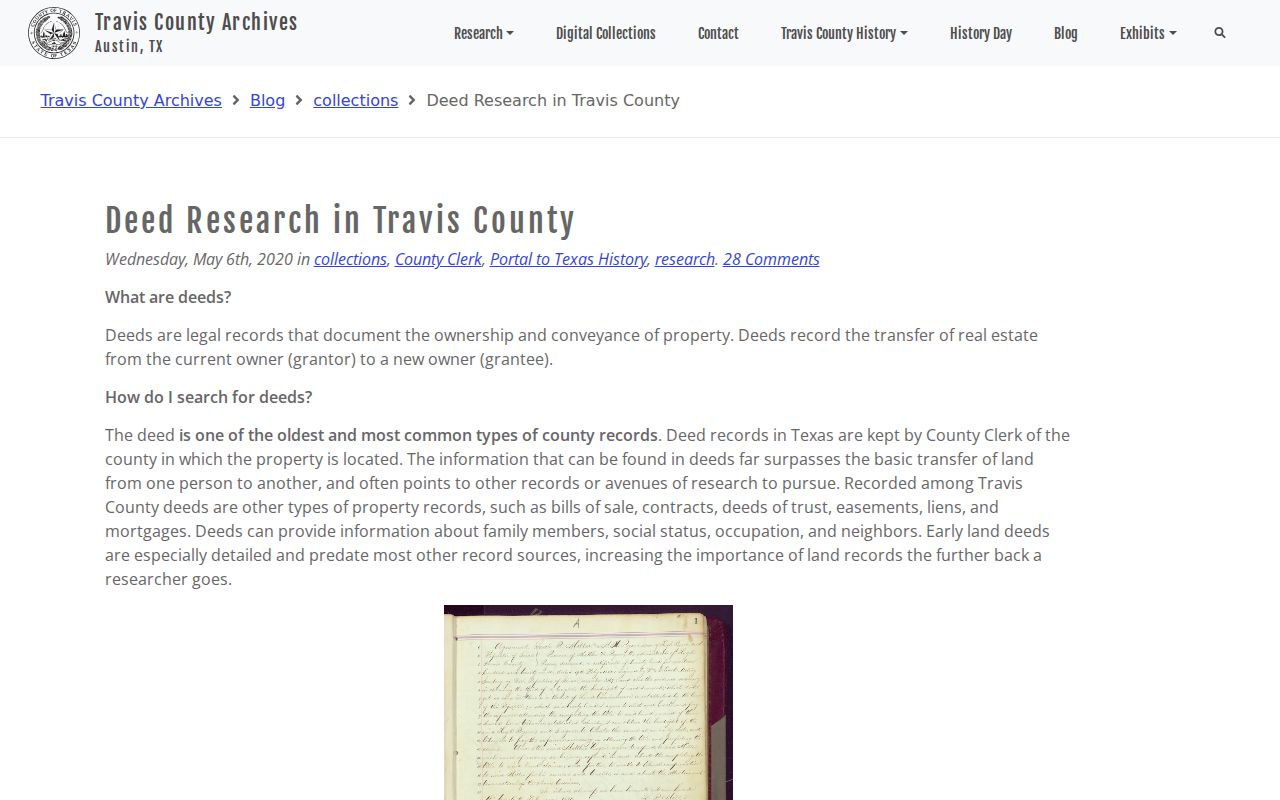
The guide reinforces why the legal description and recording reference must travel with the address through each older link.
Travis Deed Index Coverage Breaks
Travis title research has three main access layers. TCC Search provides online grantor, grantee, combined-name, and available image access for the mid-1980s to the present. Deeds from 1840 forward exist in the county record system. The Portal to Texas History is digitizing deeds from 1840-1919 and indexes from 1842-1924. Much of the 1919 through mid-1980s period is most likely to require microfilm or Archives help. That middle gap should be expected, not mistaken for an absence of a transaction.
The County Clerk Recording Division keeps a permanent library with older material on microfilm and newer material online. Its main counter is at 5501 Airport Boulevard, Suite 100B, and its search and copy routes include counter, mail, copy, and certification service. A request under the Texas Public Information Act route must seek existing records, state the department, date range, record type, address or name key, and desired format. It does not require the clerk to create a new research result.
The Austin History Center research page identifies reading-room research, remote short factual queries, Portal to Texas History, online collections, TARO finding aids, and library database access. It complements, rather than replaces, County Clerk title evidence.

Reading-room and archive routes matter most when an online index ends before the needed transfer or address reference.
Pair Past Travis Residents with Census
Ownership is only one layer of an address history. To study who lived there before, pair deed dates with the dated household sources at Austin History Center. Its criss-cross directories begin in the listed 1957 period and can turn an address into an occupant or subscriber lead. The normal alphabetical directories can then add an occupation, spouse notation, or publication-status clue. The collections themselves are described on the Travis city directory page.
- Find the address in a criss-cross directory for a year within the 1957-forward run and record the result as a publication snapshot.
- Check the same year in the alphabetical directory, preserving spelling, spouse notation, address, and any status clue.
- Work backward through available directory years, including the digitized Austin volumes and onsite gaps, while keeping old street names and numbers.
- Pair the closest available directory year with the applicable federal census schedule through HeritageQuest or a documented library source.
- Use deeds, tax rolls, maps, newspaper notices, house files, cemetery ledgers, or probate indexes to resolve a move, death, or conflicting address.
A directory is an annual snapshot compiled before or during its nominal year, while a census has its own date and scope. A missing name can reflect a non-listing instead of an empty property. HeritageQuest is available through the library's remote login route, while Ancestry Library Edition requires a library computer. Keep the evidence roles distinct: a directory can associate a person with a printed address, a census can describe a household at its census date, and a deed records a title transaction.
Travis House Files by Address
Austin History Center house and building files are arranged by street address, unlike deeds. A file may have photographs, permits, architectural notes, ownership leads, maps, or preservation research. Most are not digitized. Request the exact address and a historic street name in the reading room, then compare any result with the directory's first listing, Sanborn or plat evidence, AB+C permits, code material, and the deed chain.
The Austin History Center digital collections offer thousands of items that can be browsed by material type and collecting unit. They are useful for a first pass, while an unscanned house file requires an in-person request. The property guide cautions that an estimated construction date based on a first directory appearance may reflect information collected in the prior year.
A digital-collections search can supply a dated image or reference lead, but it does not stand in for the full address-organized file.
Travis Historic Street Names Need Dates
Address history requires a comparison of names as well as numbers. Water Avenue appears in Austin's 1839 plan, First Street appears in 1887, and the street was renamed César Chávez Street in 1993. At the time of the 2026 research, the City of Austin described a current public-feedback process concerning a potential name change. The responsible search practice is to retain the historic name and the date used by each directory, deed, map, or newspaper record.
Downtown east-west tree names also changed to numbered streets around 1897-98. Before the first identified 1905 street-list cross-reference, a direct street search may fail even when an owner, lot, or legal-description route works. Use Austin Address Management, the street-name database, lot registers, deeds, maps, and newspaper notices as comparison sources, not as interchangeable proof.
Travis Tax and Lot Records
When a parcel predates a useful directory or the first street cross-reference, Travis historical tax and land records can anchor an owner-and-date timeline. Historical tax rolls span 1840-1995, land registers 1877-1936, and city lot registers 1879-1974. A tax roll may show an assessed owner, property or lot, value, and year-specific location context. It may not identify an occupant, so it works as a bridge between a deed chain and household sources rather than a substitute for either.
Newspaper microfilm, obituaries, probate, and cemetery ledgers can provide endpoints or family context. The Austin History Center cemetery database covers mainly 1866-1921 records from defined Austin cemetery ledgers and may include burial date, age, birthplace, cause of death, profession, and plot information. Cross-check a family-provided obituary against a dated directory, deed, or registrar record before merging identities.
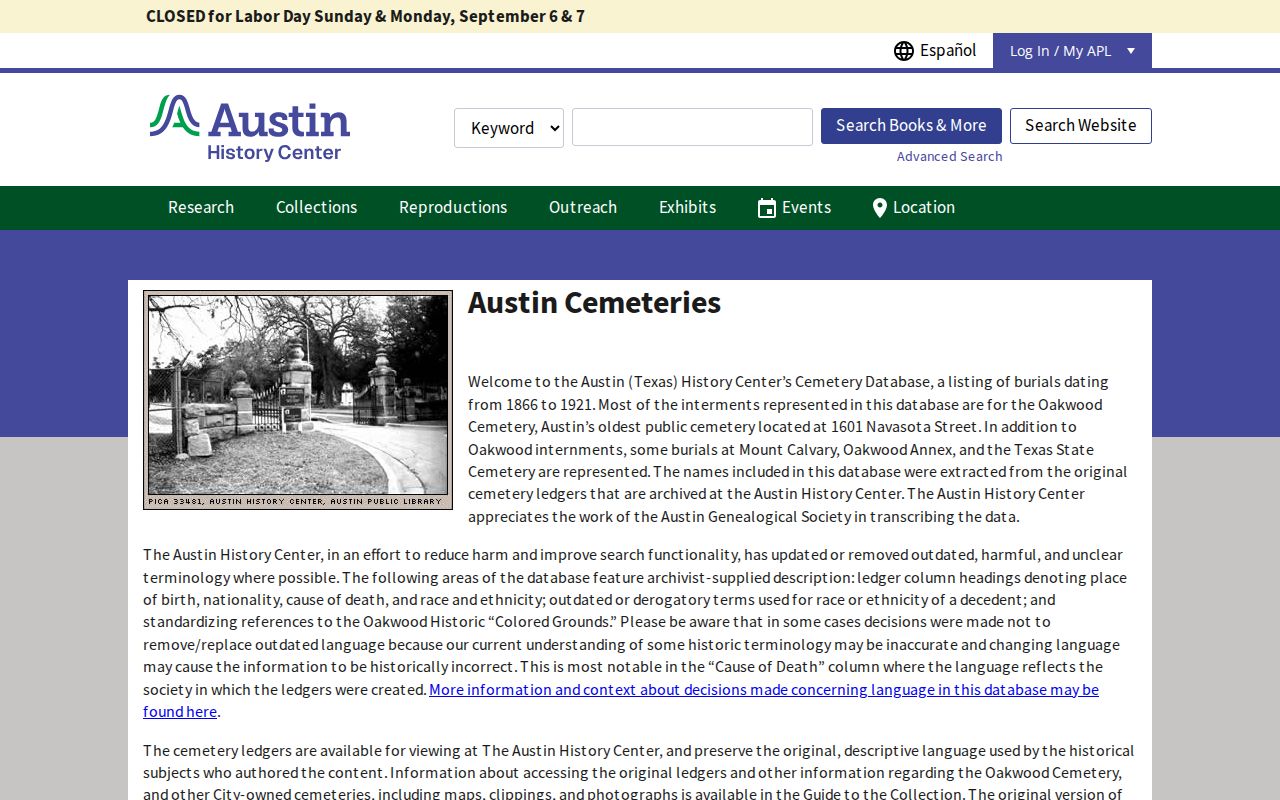
A cemetery entry can close a historical timeline, but it does not establish who lived at an address in every earlier or later year.
Travis Previous Resident Research Limits
A careful address history distinguishes a parcel, a transaction, a publication snapshot, and a person. A TCAD owner can differ from the person at the situs address. A deed names transfer parties. A directory can omit a household. Public records can also be incomplete, restricted, redacted, sealed, or tied to a different jurisdiction. Keep conflicting dates instead of silently selecting the newest address, and obtain certified title evidence from the County Clerk when that level of proof is needed.
Lawful use. Travis address history is appropriate for family history, estate research, preservation, and personal curiosity. Do not use a historical lead to stalk, harass, or track a living person.
Travis County Archives, at 5555 Airport Boulevard, Room 507, offers appointment research and reported no-fee searches and copies at the time of research. Texas State Library microfilm, County Clerk counter and mail routes, Austin History Center reading-room help, remote factual queries, and library computer access provide practical alternatives when a web search reaches its limit.