
Finding Travis Residents by Record Key
For a current property question in Travis, begin with the address or owner name. For a person question, keep the full name, an approximate date, and a known city or county connection together. That small set of details helps separate a parcel owner, a party to a court case, a voter-status result, or a directory subscriber. None of those labels alone proves who occupies an address today. Travis County records are distributed among county, state, and Austin custodians, so the useful result is usually a trail that can be checked again.
Use the key that the record system actually accepts. An address works well for appraisal, map, permit, and old reverse-directory work. A name works in the court and deed indexes. A date can narrow an archival volume or a vital-index request. When a result does not fit the known address, jurisdiction, or time period, stop and test the next source rather than treating a single hit as identity proof.
- Normalize an address or confirm its jurisdiction with Austin Address Management Services when the location may be in Austin or unincorporated Travis County.
- Check the Travis Central Appraisal District record for the parcel, its situs address, account number, and legal description.
- Use the County Clerk grantor and grantee index to connect the parcel owner to recorded instruments.
- Use an individual voter-status or court search only with the required identifiers and respect protected or suppressed results.
- For older households, compare a city directory, archive, map, or newspaper record by the same year and address.
Note: A name in a public index identifies a record relationship, not a blanket statement about a person’s present address.
Travis Resident Records Offices
Three offices create the most useful starting points for Travis resident research. The appraisal district connects an owner to an assessed parcel. The County Clerk preserves recorded instruments and county court functions. Texas election tools provide a limited, individual registration route with confidentiality safeguards. Austin departments add municipal address and permit context only where the address is in their service area. Each office answers a different question, and each has a counter or request route for material that does not appear online.
Travis County Clerk Recording Division
5501 Airport Blvd., Ste. 100B
Austin, TX 78751
(512) 854-9188, option 7
Travis Central Appraisal District
Property and parcel records
Travis County, Texas
Texas voter registration route
Individual registration status
Statewide lookup with privacy limits
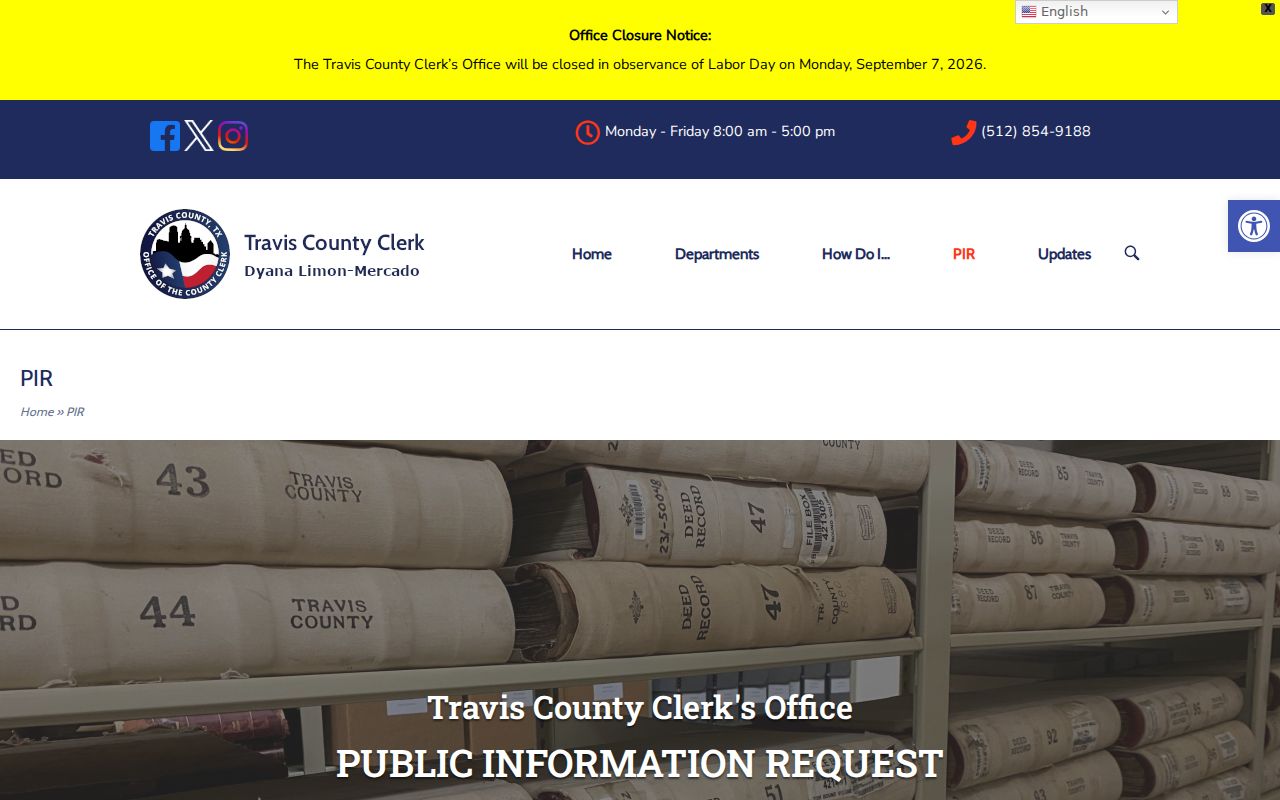
The County Clerk’s public-information request route is for existing records, not for a newly assembled roster. A concise request names the department, record type, date range, and the address or name key. Under the Texas Public Information Act, the custodian may provide records, seek clarification, or invoke a permitted exception.
Travis Property Search by Address
The Travis Central Appraisal District property search is a strong first stop when a Travis address is known. It supports owner name, property address, account number, and DBA modes, with property and map search choices. TCAD advises searchers to omit street suffixes such as St or Ave when a result does not appear and to broaden from a full number to the street name when needed. A result can provide an owner name, situs location, mailing address, account or PID, legal description, value context, exemptions, and physical characteristics when that card view is available.
| TCAD field | How it helps a Travis search |
|---|---|
| Owner name | Finds appraisal accounts under a spelling or initial variation. |
| Property address | Locates the situs parcel; try the street name without a suffix if needed. |
| Account number | Crosswalks a known appraisal or parcel identifier. |
| DBA | Supplies an assumed-name lead, not a residence conclusion. |
See the TCAD search interface before entering a Travis address.

The interface reinforces the difference between a property location and a mailing address. A mailing field can belong to an owner, lender, representative, or another location, so it should not be read as a current household listing.
Travis Deed Parties and Parcel Trails
A Travis parcel can be linked to prior recorded parties through the County Clerk’s grantor and grantee indexes. The modern real-estate index reaches much of the mid-1980s forward. Older deeds exist from 1840, while 1840 through 1919 deeds and 1842 through 1924 indexes have digitization routes, and much of the 1919 to mid-1980s span remains a microfilm or Archives task. Search both directions because the same person can be indexed as a transferor in one instrument and a recipient in another.
- Parcel
- A mapped unit of land with its own account or identifier, not a list of everyone there.
- Index
- A finding tool that points to a record; it is not always the record image itself.
- Grantor and grantee
- The transferor and recipient named in a recorded instrument.
- Legal description
- The lot, block, survey, subdivision, or metes-and-bounds wording that bridges an address to older deeds.
Use the County Clerk search and copies information to check online coverage and copy choices.
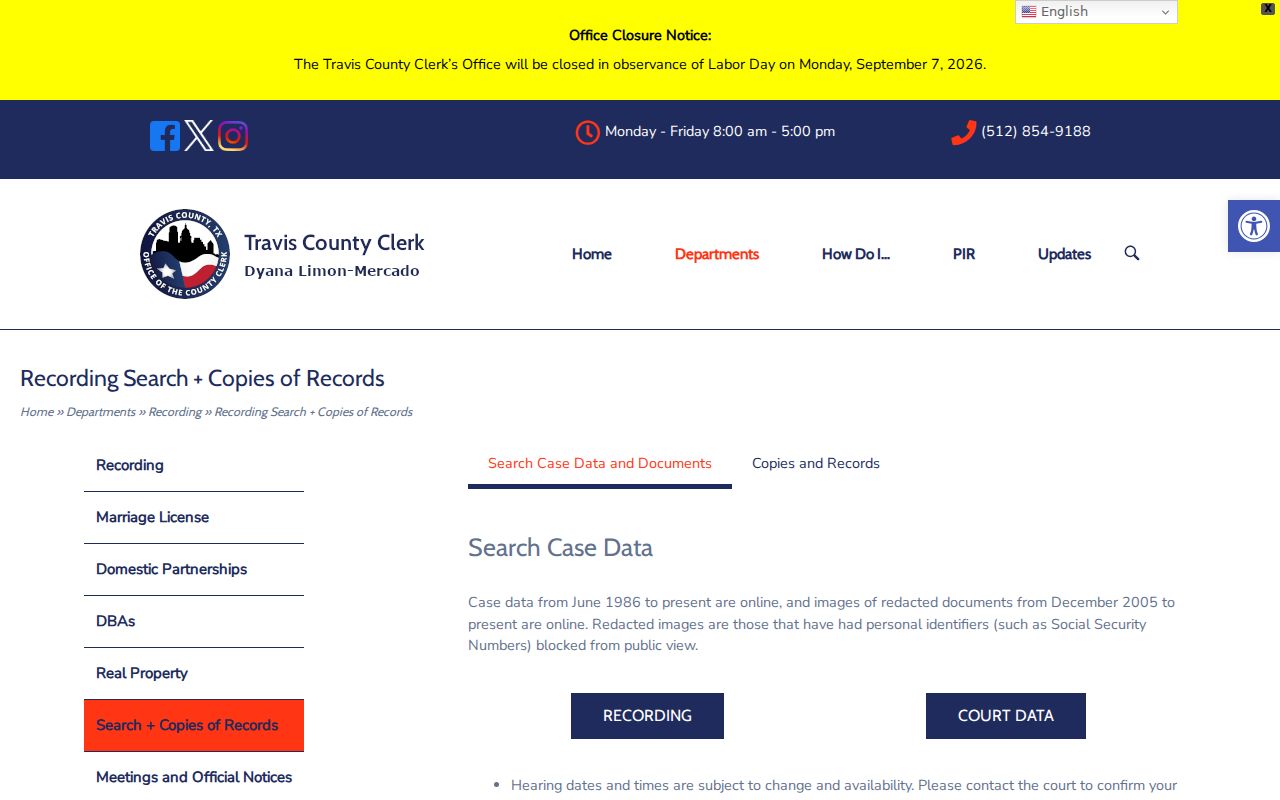
For a complete title question, verify the image or certified record through the Clerk. A deed trail shows transactions and legal descriptions, not a current resident roster.
Current Travis Resident Directories
Current Travis directory-like sources each have a narrow purpose. The appraisal roll is about parcels and assessed owners. Recorded instruments identify people and entities connected to transactions. My Voter Portal is designed for an individual registration-status check, not a whole-street display. Courts index parties and case activity. The Austin Community Registry is an organization-level resource with boundaries, meeting information, and public contacts. Keeping the source purpose in view prevents a property, civic, or court record from being treated as proof of present residence.
| Travis source | What it confirms | Custodian | Access |
|---|---|---|---|
| TCAD property search | Assessed owner and parcel context | Travis Central Appraisal District | Free online search |
| Recorded-instrument index | Parties, dates, and title clues | Travis County Clerk | Online range plus counter and copies |
| My Voter Portal | Individual registration status | Texas Secretary of State | Individual lookup; protected data stays restricted |
| Odyssey court search | Party and docket-index context | County, District, and Probate clerks | Online range plus clerk access |
| Community Registry | Organization and boundary context | City of Austin | Name or five-digit ZIP search |
| Official record path | Commercial compiled result category |
|---|---|
| Shows its custodian, date, and record type, with a counter or request route. | May combine dated public, marketing, or self-reported associations without showing their source or update date. |
| Can be checked against an image, record number, or agency instruction. | Needs independent verification before it is used as a lead. |
When one person is the focus, the Travis resident lookup route keeps the records separate and shows how to compare them.
Travis Voter Status and Protected Addresses
Texas voter tools can help an individual confirm registration status when the person has the necessary identifiers. The public-facing result is limited. Texas guidance distinguishes fields that may be public from protected identifiers such as Social Security, driver-license, and DPS ID numbers. Address suppression and the Attorney General Address Confidentiality Program protect qualifying people. A missing address or limited result is not an error to work around by combining sources. It is a boundary that should be respected.
Open the Texas voter lookup for the state’s individual search path.
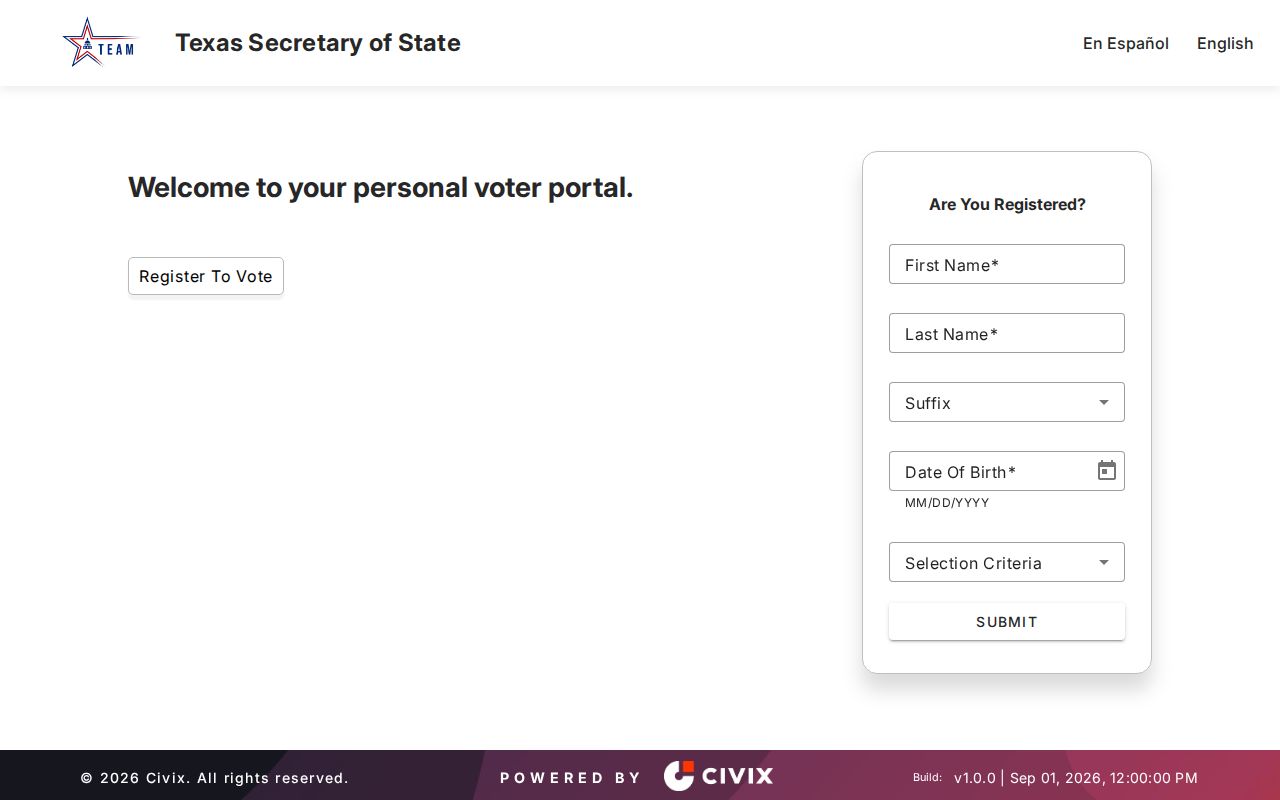
The displayed controls use individual information to narrow a status check. They do not create a public Travis block or street roster.
Texas also explains voter public fields and address confidentiality on its address-confidentiality guidance.
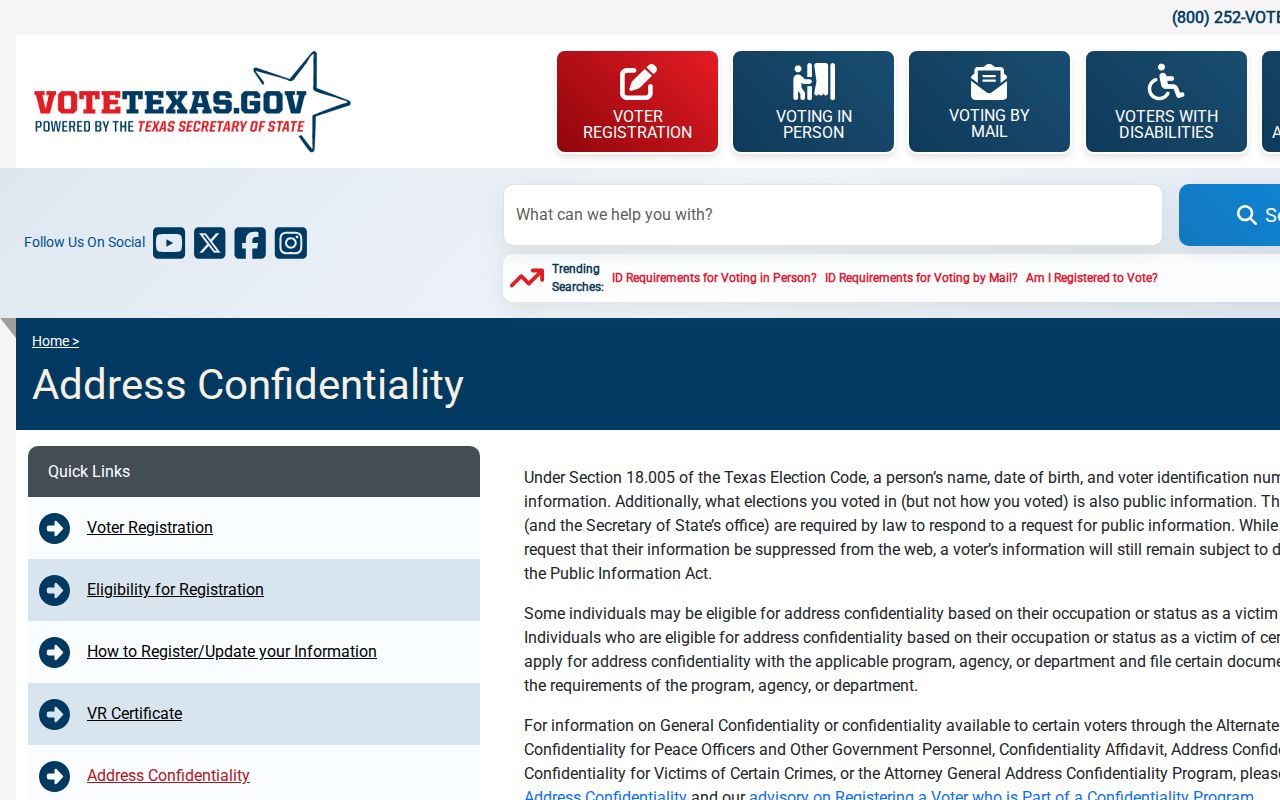
Use the state guidance to recognize when an absent address or identifier is protected rather than incomplete.
Travis Court Names Need the Right Clerk
Court research in Travis begins by routing the matter to the right level. The County Clerk handles county civil, probate, and misdemeanor records; the District Clerk handles district civil, family, and felony records; Austin Municipal Court and federal court use their own systems. The Odyssey guide permits a record number or a name in Last, First Middle Suffix format, with County Clerk, District Clerk, Probate Court, or all-locations choices. Result columns can include party or style, file date, type, and status.
A court result is an index lead. Older material can require a clerk counter, written copy request, Law Library routing help, Archives, or Texas State Library microfilm. Sealed, juvenile, adoption, mental-health, and expunged material can remain restricted. The Odyssey user guide explains the search fields and location choices.
Note: A court-party match should be compared with dates and another independent Travis record before it is treated as an identity match.
Travis Vital Record Routes by Event
Vital records are routed by event place, year, and eligibility. Travis County Clerk historical birth and death records cover 1903 through 1956. Austin Vital Records has its own listed periods and limits for events inside its full-purpose jurisdiction, while Texas DSHS is the statewide application and index route. Texas Government Code §552.115 generally keeps birth records confidential for 75 years and death records confidential for 25 years. An index entry, an uncertified copy, and a certified record have different uses and access rules.
Start with the Texas DSHS vital applications and forms when the state route is appropriate.
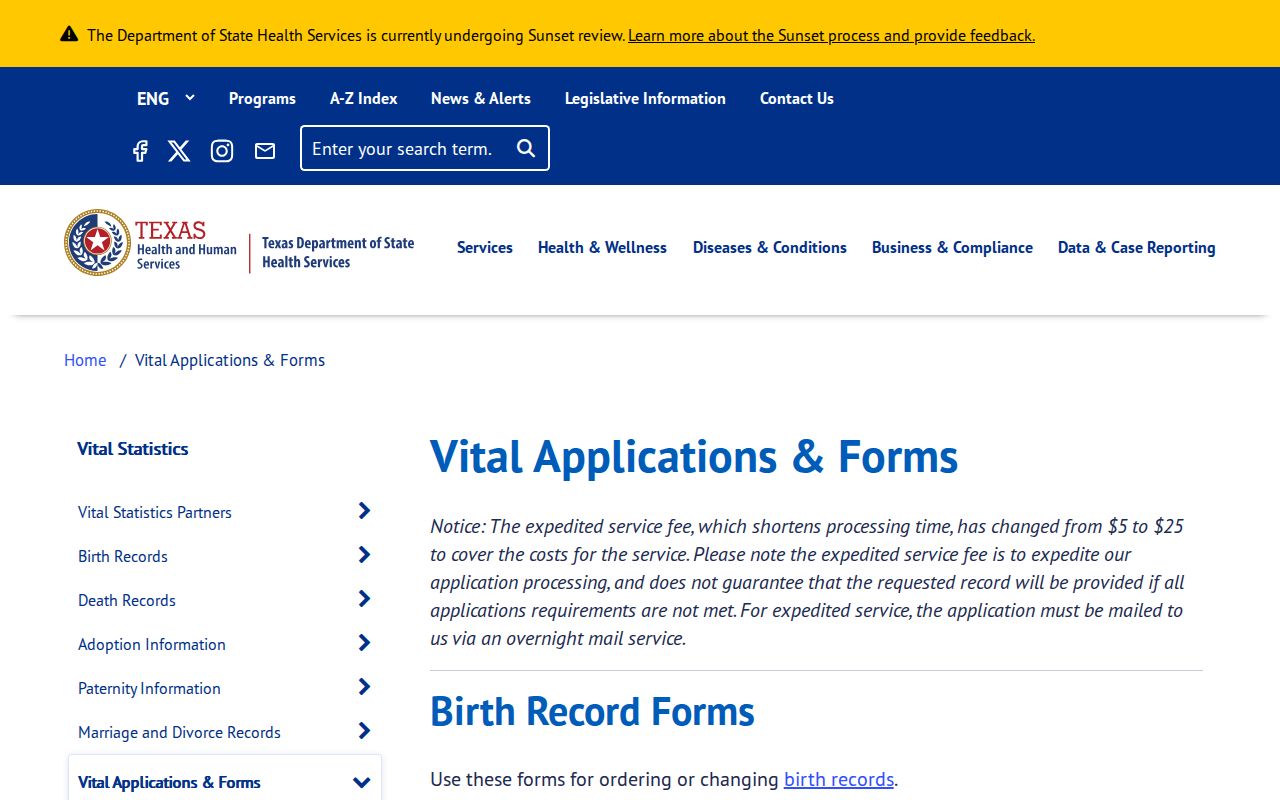
The form catalog is a request route, not an open search of recent certificates. Qualified applicants and acceptable identification remain part of the process.
Travis Jurisdiction Before a City Search
Travis County includes Austin, other incorporated places, unincorporated communities, and postal-city addresses that do not share the same municipal custodian. Before using an Austin permit, code, or address record, check whether the address lies in Austin’s service context. Austin Address Management can show a valid range, parcel ID, jurisdiction, county, units, annexation history, legal description, and zoning context. For another Travis municipality, begin with that municipality’s records office instead of assuming that an Austin portal covers the address.
The location key can change over time. Water Avenue appeared in Austin’s 1839 plan, First Street was used in 1887, and César Chávez Street received its current name in 1993. Older directories, deeds, and newspapers may use a historical name. Preserve the old name and the year in research notes, then compare maps, the street-name database, and the address profile instead of forcing a modern label onto an old record.
Historical Travis Resident Directories
The Austin History Center is the key shelf for historical Travis directory work. Its biographical guide identifies Austin city directories from 1872 to current with gaps, telephone directories from 1905 with gaps, criss-cross directories from 1957 forward, and selected Travis County directories for 1894-95, 1898-99, 1901, 1954-62, and 1972. A directory can connect a name to an address, occupation, spouse notation, or later ownership notation for one publication year. It remains an annual snapshot, not a continuous or complete household roll.
The full collection, its digitized years, entry fields, and reading-room path are detailed in the Travis city directory collections. For an address trail, pair the printed entry with a parcel, deed, map, or archive record from the same period.
Travis Cemetery Ledgers and Yearbooks
The Austin History Center’s cemetery database adds a focused historical source for Travis research. Its historical ledgers, mainly from 1866 through 1921, can include burial date, age, sex, race or ethnicity, birthplace, cause of death, physician, plot, profession, and remarks. Those fields make it more detailed than a bare name entry, but they describe a historical burial record, not a current address. Cactus yearbooks, school annuals, newspaper microfilm, and HeritageQuest can supply dated context when a directory trail has reached a person or household.
The Austin History Center cemetery database is a historical resource. A death date, directory entry, deed, or DSHS index can help test whether a record belongs to the same person before the trail is extended.
Travis Archives Beyond the Web Index
Older Travis material does not disappear simply because the modern index does not return it. County deed records begin in 1840, and historical tax rolls run from 1840 through 1995, with land registers from 1877 through 1936 and city-lot registers from 1879 through 1974. The Travis County Archives offers appointment research at 5555 Airport Boulevard, while the Austin History Center, Portal to Texas History, and Texas State Library microfilm guide supply complementary finding aids, digitizations, and reels. The County’s preservation and imaging work also explains why a record group may be in transition.
Use the Travis County Clerk Public Information Act route for an existing county record when the responsible department has material that is not online.
A focused request, archive appointment, or microfilm citation preserves the source trail. It is better evidence than an unsupported conclusion from an absent web result.